Updated 0s ago · Free board, delayed at least 60 s
Michael Saylor @saylor on X
Michael Saylor has posted 0 times so far today, Sunday, November 22 (New York time), against a usual 1 by this hour.
- Today
- 0
- Usual by now
- 1
- Last 7 days
- 41
- Daily average
- 5.9
Below usual
Latest posts
- RepostMichael Saylor reposted
- RepostMichael Saylor reposted
- Post
- RepostMichael Saylor reposted

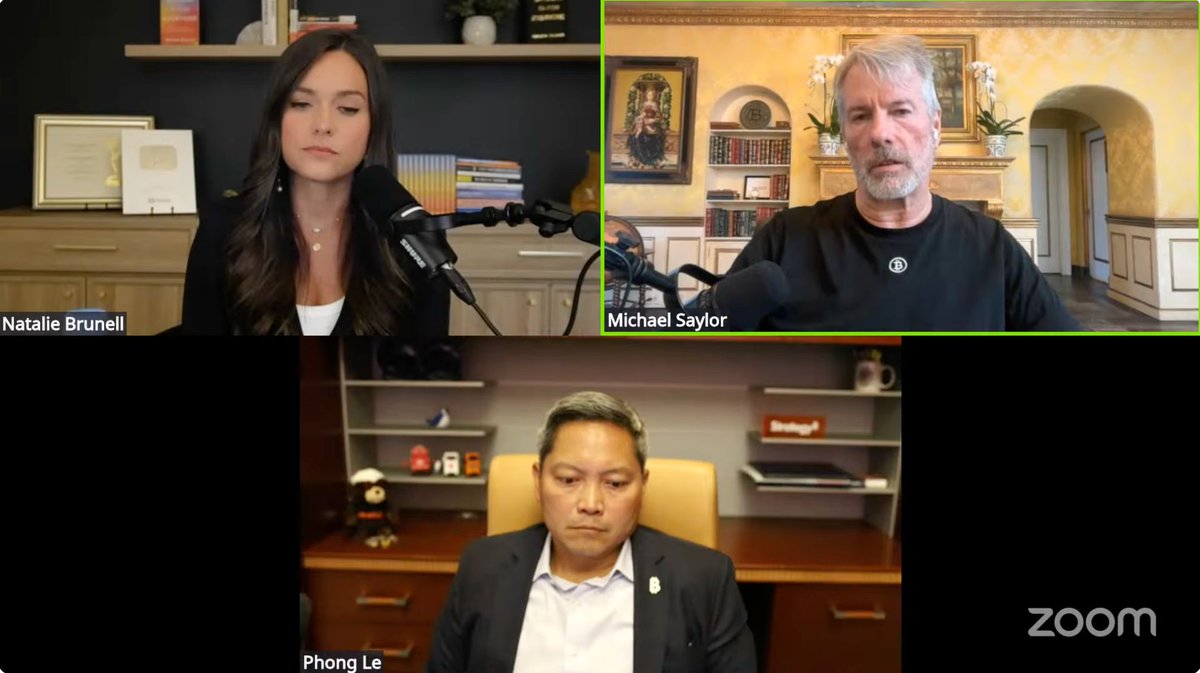
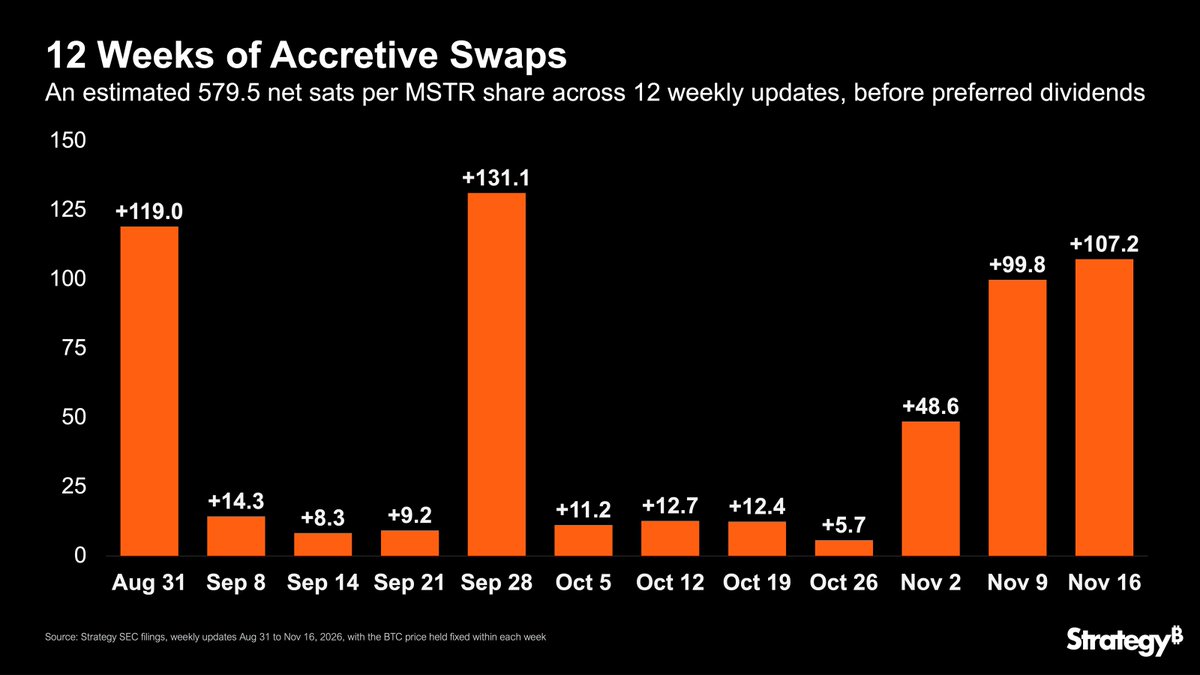
If you're an $MSTR investor, grab a coffee and get comfortable. Natalie Brunell's Q&A with Michael Saylor and Phong Le yesterday was one of the most revealing discussions I have seen. And actually it couldn't have come at a better time considering the recent market dynamics. My full thoughts below on what stood out to me. 1. Digital Credit Is The Business Model Saylor made it explicitly clear that creating Digital Credit is central to Strategy's business model. "The number one way that the company creates shareholder value is to issue good credit." By issuing Digital Credit and investing the proceeds in $BTC, Strategy can capture the spread between its Cost Of Credit and Bitcoin's appreciation. The more efficiently Strategy can issue Digital Credit, the greater the economic spread it can capture. And the more successfully it can scale that model, the more value it will create for common shareholders. 2. $STRC Buybacks Are About Building Trust Saylor emphasised that supporting Digital Credit during difficult market conditions is essential to building long-term customer confidence. "People judge you based upon how you treat them in difficult markets." This reinforces something I have been arguing for months. Supporting $STRC through buybacks demonstrates Strategy's commitment to its customers. Management explicitly discussed the downstream implications of this approach, including stronger investor confidence. In turn, that confidence will attract more durable investors, improve liquidity and ultimately increase Strategy's capacity to issue Digital Credit. Saylor also acknowledged that decisions which appear less profitable in the short term can become considerably more valuable in the long-term. For reasons I have explained many times elsewhere, I believe management is making the right decision by prioritising the long-term success of the product over short-term financial optimisation. 3. Product Quality Over Short-Term Growth Saylor acknowledged that higher dividend rates could stimulate additional demand for $STRC, but explicitly rejected pursuing growth at the expense of common shareholders. "There might very well be more demand for this if we were paying 15% or 20% than 12%...We just don't wish to do that." His reasoning was straightforward. Raising the dividend would increase Strategy's Cost Of Credit and reduce the economic spread available to $MSTR shareholders. As Saylor put it: "We're playing the long game." Instead, Strategy is prioritising price stability, liquidity and investor confidence. Again, I strongly agree with this approach. Higher dividend rates may attract incremental demand, but they won't necessarily attract the type of durable institutional investors Strategy is targeting. And increasing the Cost Of Credit ultimately comes at the expense of common shareholders. 4. $STRC Supply Will Adjust To Demand Saylor explained that Strategy intends to continuously adjust outstanding $STRC supply according to organic demand rather than pursue issuance growth at any cost. He estimates that the current level of organic demand for $STRC at a 12% dividend is approximately $5B–$7.5B. I have no real view on how accurate those numbers are likely to turn out to be. If anything, I would lean lower. To date, Strategy has repurchased ~$3B of $STRC below par. Per Saylor, the objective is to establish an equilibrium where buyers and sellers balance around par. This is something I have consistently advocated. Maximise the proportion of holders who genuinely want the product for what it is at the minimum sustainable dividend rate. That establishes a stable foundation upon which future growth can compound. 5. Capital Allocation Is Dynamic Saylor explained that Strategy evaluates capital allocation opportunities across Bitcoin, common equity, Digital Credit and cash on an ongoing basis. "We can buy or sell dollars, buy or sell Bitcoin, buy or sell MSTR common stock, buy or sell STRC." Crucially, management evaluates these transactions against different accretion thresholds rather than relying on a single mNAV multiple. For example, retiring $STRC through $MSTR issuance can increase net Bitcoin Per Share even when $MSTR trades below 1x mNAV. Saylor also explained that retiring Digital Credit liabilities strengthens net reserves, reduces risk and creates additional capacity for future credit issuance. This aligns with my view that capital allocation decisions should ultimately be judged by their long-term impact. 6. Balance Sheet Resilience Is Improving Saylor highlighted how significantly Strategy's balance sheet has strengthened during the recent market downturn. "We've got three years of cash right now, 3.4 years or something." He also explained that Strategy continuously adjusts its capital structure in response to changing market conditions rather than relying on infrequent refinancing transactions. I love this because it means the company can reduce risk by retiring Digital Credit liabilities when credit markets contract. The combination of ~3.4 years of USD liquidity coverage and greater capital allocation flexibility considerably strengthens Strategy's ability to withstand stressful market conditions. 7. Liquidity Is Becoming A Competitive Advantage Saylor emphasised that the liquidity of $STRC is becoming an increasingly important part of Strategy's competitive positioning and future issuance capacity. "STRC traded $600 million yesterday." He explained that this liquidity, combined with Strategy's shelf registration and capital markets infrastructure, allows the company to issue substantial amounts of Digital Credit rapidly when demand returns. He also made clear that institutional credibility takes time to establish. "It took us four years of work to build the credibility and the trust in the market." I see liquidity, distribution and credibility becoming increasingly important competitive advantages. And when institutional demand eventually accelerates again, Strategy will be much better positioned to capture that opportunity at scale. Summary (TL;DR) This discussion reinforced the fact that Strategy's long-term success will ultimately depend on its ability to build a trusted, scalable Digital Credit business. And for me, management is making the right decisions to achieve that. By prioritising product quality, price stability and investor confidence over short-term issuance growth, Strategy is laying the foundations for a considerably larger business over time. The stronger the product, the greater the confidence. The greater the confidence, the more durable the demand. And the more durable the demand, the greater Strategy's capacity to issue Digital Credit, acquire Bitcoin and compound Bitcoin Per Share. Of course, none of this eliminates the importance of disciplined capital allocation, balance sheet resilience or Bitcoin outperforming Strategy's Cost Of Credit. But I believe the decisions management is making today will have a disproportionate impact on the company's ability to create shareholder value over the next five to ten years. The foundations of a successful Digital Credit business are being established today. The real opportunity will be realised as that business scales. As Saylor put it: "Strong credit makes a strong treasury company." I couldn't agree more.
- Reply

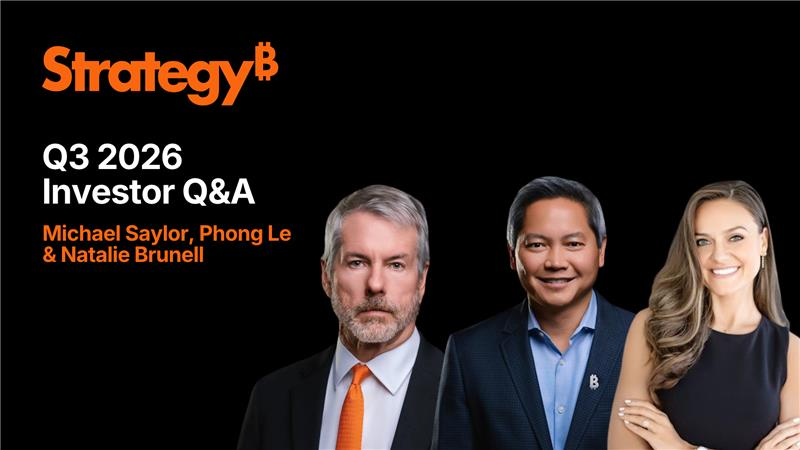
How do we decide when to buy Bitcoin and when to buy back $STRC? In Strategy’s Q3 2026 Investor Q&A with @NatBrunell, @PhongLe and I answered your questions about Bitcoin Per Share, funding dividends through a downturn, and creating long-term value for $MSTR shareholders. 02:05 - How $MSTR, $STRC, other preferred shares, and convertible debt fit into Strategy’s capital structure 08:09 - Creating value for $MSTR shareholders beyond $BTC appreciation 11:53 - When we issue equity, buy Bitcoin, and repurchase $STRC 24:38 - What Gross and Net Bitcoin Per Share tell us about accretion, risk, and long-term value 37:18 - $STRC repurchases, the $100 target price, and credit market dynamics 51:40 - Managing amplification and risk while maintaining balance sheet strength 53:06 - Funding dividends and meeting debt obligations through a prolonged Bitcoin downturn 57:42 - How liquid Digital Credit creates value for $MSTR shareholders 01:04:34 - Strategy’s vision for scaling Digital Credit, $STRC, and Digital Money over the next 3–7 years
You can also watch our full Q3 2026 Investor Q&A on YouTube. https://t.co/P0Zs1V6wbv https://t.co/qbCk9j2iJ3
- Post
How do we decide when to buy Bitcoin and when to buy back $STRC? In Strategy’s Q3 2026 Investor Q&A with @NatBrunell, @PhongLe and I answered your questions about Bitcoin Per Share, funding dividends through a downturn, and creating long-term value for $MSTR shareholders. 02:05 - How $MSTR, $STRC, other preferred shares, and convertible debt fit into Strategy’s capital structure 08:09 - Creating value for $MSTR shareholders beyond $BTC appreciation 11:53 - When we issue equity, buy Bitcoin, and repurchase $STRC 24:38 - What Gross and Net Bitcoin Per Share tell us about accretion, risk, and long-term value 37:18 - $STRC repurchases, the $100 target price, and credit market dynamics 51:40 - Managing amplification and risk while maintaining balance sheet strength 53:06 - Funding dividends and meeting debt obligations through a prolonged Bitcoin downturn 57:42 - How liquid Digital Credit creates value for $MSTR shareholders 01:04:34 - Strategy’s vision for scaling Digital Credit, $STRC, and Digital Money over the next 3–7 years
- RepostMichael Saylor reposted

Structure matters for Digital Money. Saturn’s senior tranche, srUSDat, has recorded zero drawdowns since inception, including through the June and November $STRC selloffs. Choose senior protection with srUSDat or higher distributions with jrUSDat.

- RepostMichael Saylor reposted

We are LIVE with @Saylor, @PhongLe, & @NatBrunell. Join us & share your questions on X and YouTube. https://x.com/i/broadcasts/2kEllOkVkoEPjJ
- RepostMichael Saylor reposted
Today! Strategy Investor Q&A with @Saylor & @PhongLe, hosted by @NatBrunell at 5PM ET. Participate LIVE on X & YouTube: https://x.com/i/broadcasts/2kEllOkVkoEPjJ
- RepostMichael Saylor reposted
- Post
$STRC traded over $600M yesterday, the only one of 456 U.S.-listed income preferreds to do so this year. We intend to keep buying below $100. Repurchases facilitate liquidity and lower dividend obligations. We believe they strengthen the credit and benefit common shareholders.
- RepostMichael Saylor reposted

₿uilt different. https://x.com/AlexesNakamoto/status/2097335632850759771/video/1 https://twitter.com/saylor/status/2123098624204710141
TranslationRT @AlexesNakamoto: ₿uilt different.
Seller exhaustion will come long before Saylor exhaustion.
- Post
- Quote

At this rate, everyone will be smart enough to buy Bitcoin. https://twitter.com/OpenAI/status/2122750124543926515
Some of you have been asking very politely. Some of you have just been asking. GPT-6.2 Astra and Sol are now available. Super efficient and built to perform where it counts—the real world. https://openai.com/index/introducing-gpt-6-2-astra-sol
- RepostMichael Saylor reposted
$STRC now powers 5+ structured products across Saturn's onchain stack. $148M+ in protocol AUM, spanning: • Digital Currency • Digital Money • Digital Credit • Digital Yield Details below.

- RepostMichael Saylor reposted

$STRC is Digital Credit: high income, low volatility, and 44 years of dividend coverage. Built for income investors as TradFi and DeFi converge. https://t.co/nA0bVC8RVt

- RepostMichael Saylor reposted

Wall Street grew its spot #Bitcoin ETF holdings in Q3, per new 13F filings Jun 30 → Sep 30: ➤ Goldman: 106K → 5.48M $FBTC ➤ BofA: 1.7M → 14.5M $IBIT ➤ Brevan Howard: 7.2M → 22.4M $IBIT ➤ Millennium: 9.7M → 20.8M $IBIT ➤ Wells Fargo: 24.4M → 49.6M $IBIT ➤ Tudor:… https://t.co/2mPEa3WYF0 https://t.co/ODoDkSzIXb

- Post
Banks are bringing Bitcoin to their clients. Wells Fargo reported 49.58 million shares of BlackRock’s Bitcoin ETF as of September 30, up 103% from June. Those shares were worth $2.35 billion. https://crypto.news/wells-fargo-blackrock-bitcoin-etf-holdings-q3/
- Post
Banks are bringing Bitcoin to their clients. Wells Fargo’s two brokerages reported 42 million shares of BlackRock’s Bitcoin ETF at the end of September, up from 20 million in June. https://crypto.news/wells-fargo-blackrock-bitcoin-etf-holdings-q3/
- RepostMichael Saylor reposted

Today Smarter Web announced a further 55 Bitcoin bought taking our total Bitcoin held to 2,905. We also confirmed the 5th MORE Weekly Dividend. MORE offers a 12% variable annual preferred dividend rate, calculated daily on a £100 reference amount and payable weekly. We continue to maintain a minimum of two years’ cash reserves to fund MORE dividend payments. The current effective yield is 14.46%. The Bitcoin purchase was funded using cash from within the business and also cash from our Coinbase Strategic Credit Facility. Borrowing under the facility now sits at approximately £19 million with a 6.25% annual interest rate. Our aim is to remove the Coinbase Strategic Credit Facility from our capital structure, as MORE is a better source of long-term capital, but we must take the steps we believe are in the best interest of our balance sheet as opportunities arise. Borrowing under the Coinbase Strategic Credit Facility is significantly over collateralised, as is the Bitcoin asset coverage against MORE. Our total amplification ratio is now 18.7%. We felt that, with Bitcoin trading at these levels, it was sensible to increase our total holdings, increase the amplification ratio and increase gross Bitcoin per share. With the expectation that, over time, positive Bitcoin price movement will translate into higher net Bitcoin per share. You can view the Smarter Web treasury analytics and the MORE dashboard on our website. LSE: #SWC #MORE | OTC: $TSWCF $MORPF | FRA: $3M8
RNS Announcement: Bitcoin Purchase and MORE Weekly Dividend Please read the RNS on our website (link in comments). LSE: #SWC #MORE | OTC: $TSWCF $MORPF | FRA: $3M8

- RepostMichael Saylor reposted

Twenty One acquired 154.32 $BTC for approximately $10 million at an average price of approximately $64,801.01 per bitcoin. $XXI funded the purchase with cash, bringing the company’s total holdings to approximately 43,668 bitcoin as of November 16, 2026. We built Twenty One because we believe in Bitcoin. That conviction doesn't change with the price. Volatility creates opportunities. We saw one, acted and bought the dip. We'll keep accumulating Bitcoin, building businesses, and working to create long-term value for our shareholders.
- Post
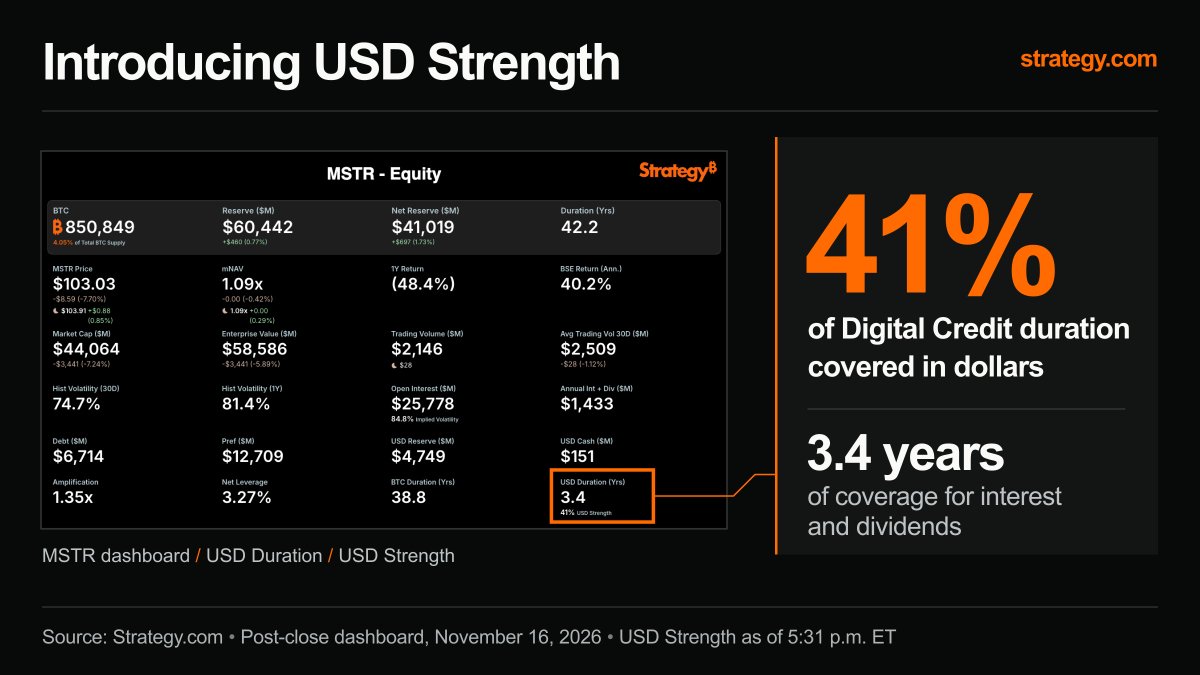
We’ve added USD Strength to the Strategy dashboard. At today’s rates, our USD assets can fund 3.4 years of interest and dividends. That’s 41% of the weighted duration of our Digital Credit. https://t.co/RsyMiNESxU https://t.co/XyFVbVCFCM
- RepostMichael Saylor reposted

We are very pleased to welcome Jesse Myers @Croesus_BTC. Jesse joins Super League now and will lead Bitcoin treasury strategy as Chief Investment Officer of Superplanet once our transaction closes and the company joins the Metaplanet group. Jesse is a well-known Bitcoin analyst and author, widely respected across the industry and best known for his Full Potential Valuation framework. At SWC in the UK, he helped develop its perpetual preferred offering. I recently spent several days with Jesse in New York, and I’m confident his experience, strategic clarity and relationships make him an excellent addition to the Metaplanet family. Superplanet’s goal is to grow Bitcoin per share over time. Super League has said it intends to issue perpetual preferred equity in the US after closing, subject to Board approval and market conditions, and Jesse will lead that work. $SLE
Excited to announce that I will be joining @Superplanetinc to lead Bitcoin strategy as Chief Investment Officer, pending transaction close. Right now, the company is known as Super League (Nasdaq: $SLE), but will become Superplanet upon completion of the proposed transaction,…
- Post











About this tracker
This page follows Michael Saylor (@saylor) on X, one of the accounts on TweetStream's live board of posts that move markets, in its Crypto group. New posts are listed newest first with their catch speed: the time from the post's own timestamp to TweetStream's first receipt. TweetStream catches X posts in typically 166 ms.
The count includes what shows on the account's main feed: main posts, quote posts, reposts, and replies that continue its own thread. Other replies are left out. Polymarket's weekly post-count rules describe the same kinds of post, but this is not their settlement figure: each market settles on the tracker its rules name. "Today" runs from midnight New York time. "Usual by now" is the average over the previous 7 days, scaled to the share of today that has passed, and the pace label says whether today is above or below it. A post deleted after TweetStream caught it stays in the count. Posts appear here at least 60 seconds after TweetStream receives them.
More in Crypto: Vitalik Buterin, Brian Armstrong, Coinbase, Binance, Watcher.Guru.